Rolex·20 August 2026·2 min read
The Daytona story
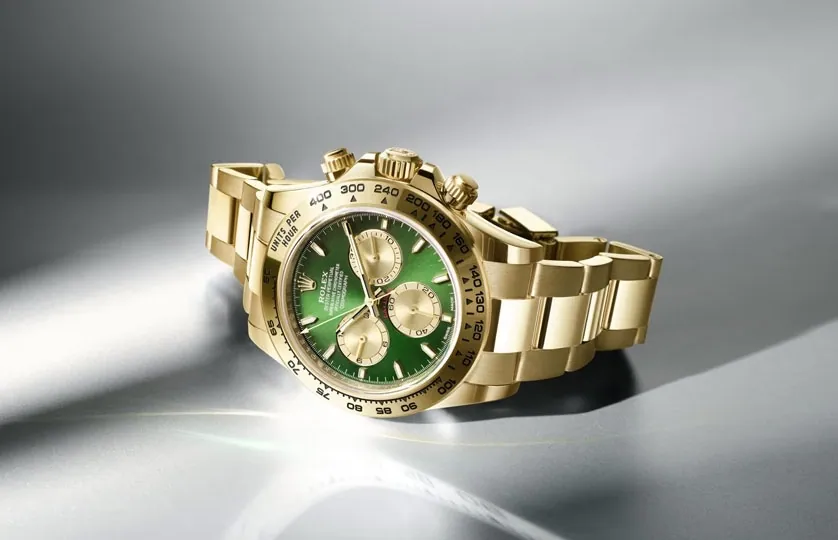
Launched in 1963 and so hard to shift that dealers discounted it. How the least wanted Rolex of the sixties became the one with the longest list.
Rolex became the official timekeeper of the Daytona International Speedway in 1962, and put the name on a chronograph the following year. Reference 6239 had a tachymeter scale moved off the dial and engraved on the steel bezel — the change that gave the watch its face — and a manually wound movement based on a Valjoux ébauche. It was called the Cosmograph. The word Daytona joined it on the dial a year or two later, in a small arc above the sub-dial.
Nobody wanted it. Through the sixties and into the seventies a Cosmograph sat in the case longer than anything else Rolex made, and dealers discounted it to move stock. A chronograph was a working instrument in an era when Rolex customers wanted a Datejust, and a manually wound one at that, in a decade when the company had spent thirty years persuading the world that automatic winding was the point.
Among the slowest sellers were the ones with what Rolex called the exotic dial: block markers, contrasting sub-dials, art-deco numerals, made by the Singer dial company. So few were ordered that the design was quietly dropped. They are now the most valuable series-produced wristwatches in existence, because in the eighties Italian collectors noticed that Paul Newman wore one, and the name stuck to the design permanently.
Newman's own — a gift from his wife, engraved on the back, worn for years — went to auction at Phillips in New York in October 2017 and sold for 17.75 million dollars. It remains among the highest prices ever paid for a wristwatch, for a steel chronograph that its manufacturer could not give away when new.
The mechanical turning point was 1988. Rolex wanted an automatic Daytona and did not have one, so it bought movements from Zenith: the El Primero, the high-frequency automatic chronograph of 1969. It then modified roughly half the parts and slowed it from 36,000 beats an hour to 28,800, which purists have complained about ever since and which made the movement last far longer between services. That watch, the 16520, ran for twelve years and is now the connoisseur's Daytona.
In 2000 Rolex replaced it with the 4130, its own design, with fewer parts than the movement it replaced and a vertical clutch that lets the chronograph start without the stutter of the seconds hand. It is generally held to be among the best chronograph movements ever put into series production. The 4131 that succeeded it in 2023 is a refinement rather than a departure.
What the Daytona demonstrates, more clearly than any other watch, is that desirability is not a property of an object. Nothing about the 6239 changed between the decade when it was discounted and the decade when it became unobtainable. The watch stayed still; everything around it moved.
For a buyer today the useful distinctions are three: the manual references up to 1988, which are collectors' territory and priced accordingly; the Zenith-powered 16520, which is the most watch for the money in the whole line; and the in-house 116500 and 126500, which are the ones with the waiting lists. We are asked for the third most often and recommend the second more often than that.
Questions about a specific reference? Ask us directly.