

The collaboration·27 August 2026·3 min read
Audemars Piguet × Swatch
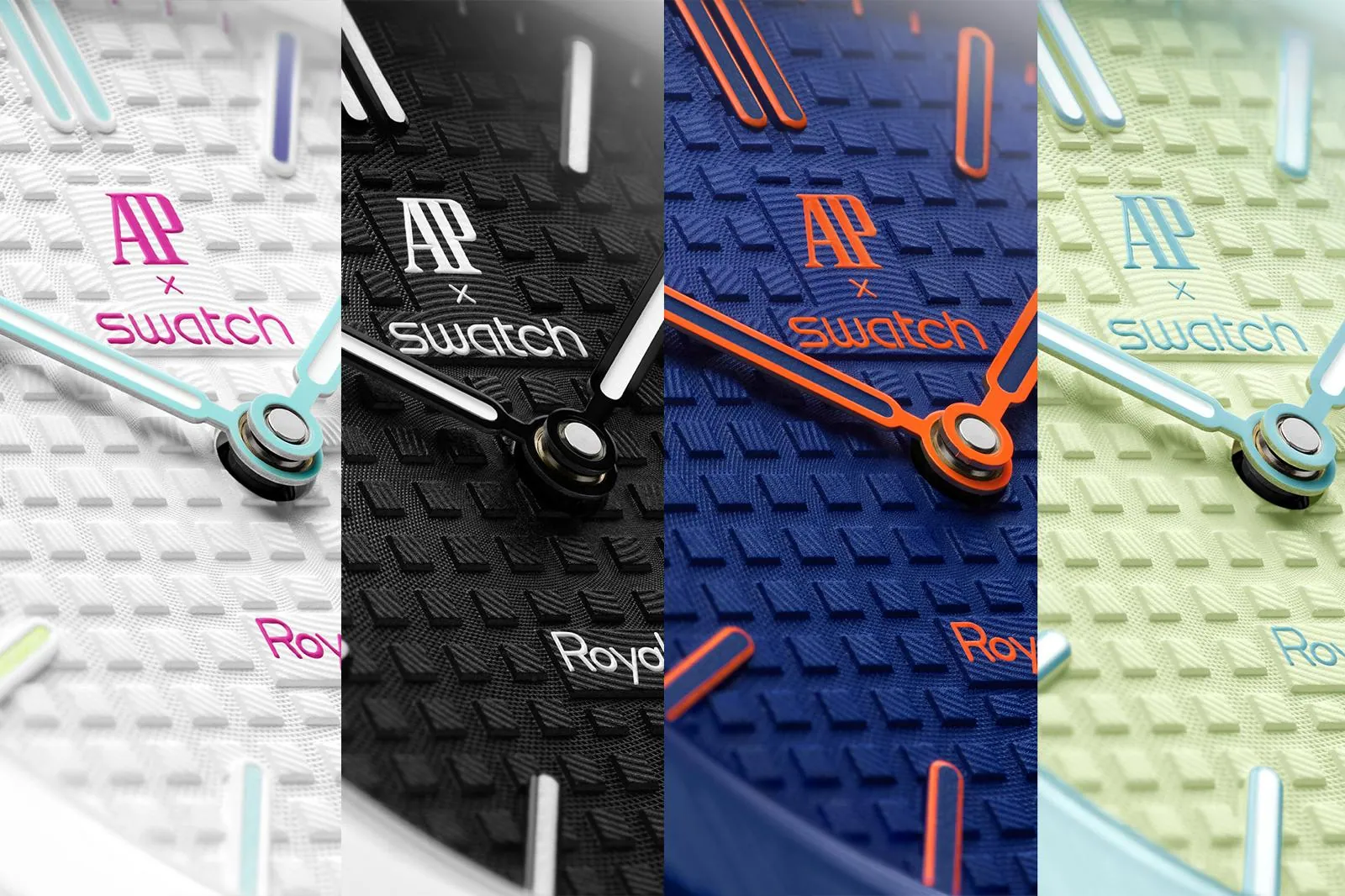
Four dials, one tapisserie pattern, and a conversation about what a Royal Oak is for. We look at what it does to the value of the originals — and what it does not.
To understand why a collaboration like this unsettles people, you have to go back to 1972, and to a watch that was itself an act of provocation.
Audemars Piguet was in trouble. Quartz was arriving, Swiss mechanical output was about to collapse, and the house was making a few thousand watches a year. Gérald Genta — who later drew the Nautilus — was asked for something new and, by his own account, designed it in a single night. What he delivered was the Royal Oak, reference 5402ST: a 39-millimetre steel case with an octagonal bezel held down by eight hexagonal screws, an integrated bracelet tapering to the clasp, and a dial covered in the small waffled squares AP calls Petite Tapisserie.
The scandal was the price. It launched at around 3,300 Swiss francs, which was more than a gold watch from Patek Philippe, and it was made of steel. Dealers thought it was unsellable. The first thousand pieces took years to move. It then went on to keep the house alive through the quartz crisis and to define, alongside the Nautilus, the entire idea of a luxury steel sports watch.
So the Royal Oak was never a conservative object. It was the cheap material sold at the expensive price, and the argument it started — that value in a watch is design and finishing rather than gold content — is the same argument a mass-market collaboration restarts fifty years later, pointed the other way.
There is a precedent worth being precise about. In March 2022 Omega and Swatch released the MoonSwatch: a Bioceramic Speedmaster in eleven planetary colourways at around two hundred pounds. Queues went round the block, boutiques ran out in hours, and examples were flipped online the same afternoon for several times retail. The predicted damage to Omega did not happen. Speedmaster demand rose rather than fell, Swatch Group said so in its own reporting, and the collectors who worried that a plastic Moonwatch would cheapen the steel one were, on the evidence, wrong. Blancpain and Swatch repeated the exercise with the Scuba Fifty Fathoms in 2023.
What the MoonSwatch demonstrated is that these releases do not compete with the originals; they recruit for them. The person queueing for a two-hundred-pound Speedmaster was not otherwise about to spend seven thousand. They were being introduced to a shape, and a proportion of them come back years later with a budget.
The one genuine difference here is ownership. Omega and Blancpain are both Swatch Group houses, so those collaborations were internal decisions. Audemars Piguet is independent, and has been family-controlled since 1875 — which makes any tie-up of this kind a negotiation between two companies rather than a memo between two divisions.
Our reading, for what it is worth to someone holding one: the tapisserie dial is a pattern, not a patent, and a Royal Oak has never been valuable because the waffle was hard to obtain. It is valuable because of a case profile that is difficult to finish correctly, a bracelet that costs more to make than most complete watches, and fifty years of a house declining to make very many. None of that is reproducible at a hundredth of the price, and none of it is diminished by something that shares a dial texture.
The pieces to watch are the early ones — A-series 5402s, and the 14790 and 15202 that followed the original proportions. Attention of any kind tends to lift the references closest to the source, and those are the three we are asked for most often when a Royal Oak is back in the conversation.
Questions about a specific reference? Ask us directly.