
Rolex·22 August 2026·2 min read
The GMT-Master and the Pepsi bezel
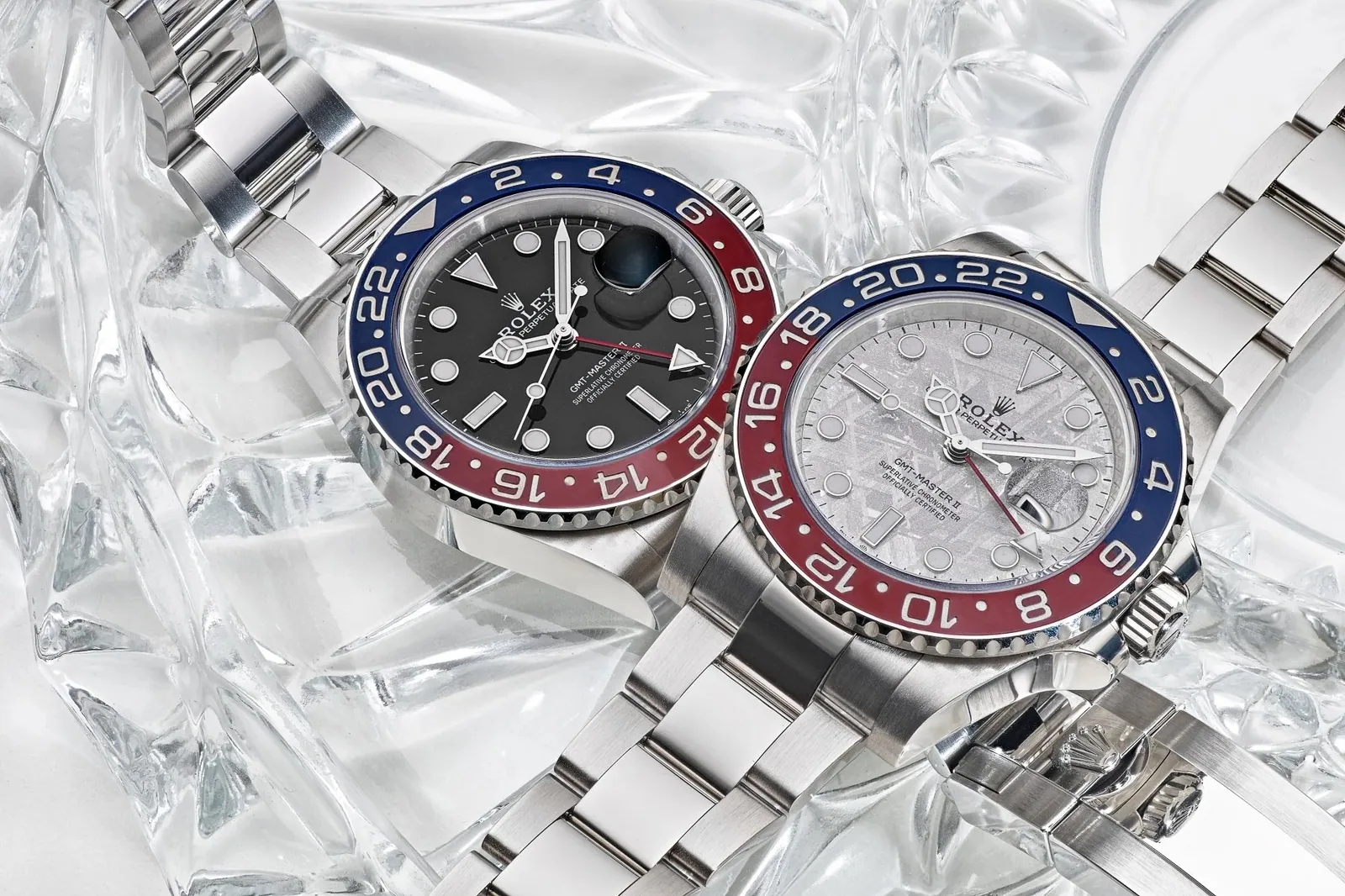
Pan Am asked for a watch its pilots could cross the Atlantic with. What came back had a bakelite bezel that cracked, an aluminium one that faded to lilac — and a red-and-blue ceramic that took Rolex until 2014 to make at all.
In the early fifties Pan American World Airways had a problem that had not existed before. Its aircraft were now crossing several time zones in a single leg, and its crews needed to hold two times at once: the local one outside the window and the reference time the airline ran on. The airline went to Rolex.
What came back, in 1954, was the GMT-Master: a fourth hand geared to turn once every twenty-four hours, read against a rotating bezel numbered to twenty-four. Set the bezel and you have a second time zone. The bezel was split red and blue so that a glance told you whether the reference hour was day or night, which is the entire reason for a colour scheme the world now calls Pepsi.
The first bezels, on reference 6542, were bakelite with the numerals filled in radium. They looked superb and they were a genuine hazard: the material cracked, and what was in the cracks was radioactive. Rolex recalled them around 1959 and replaced them with anodised aluminium, which is why an intact bakelite bezel is now one of the rarer things in the collecting world.
Aluminium brought its own behaviour. Ultraviolet light attacks the red half faster than the blue, so a bezel that spent its life outdoors fades to pink, then to lilac, while the blue holds. For thirty years that was straightforward wear. Now it is a premium — an evenly faded 1675 bezel is worth more than a sharp replacement, because it cannot be manufactured and it proves the watch was worn.
The brown-and-gold version arrived in the seventies and was christened Root Beer by everyone except Rolex. In 1982 the movement changed in a way that mattered more than any bezel: the 16760 let the hour hand be moved on its own, in one-hour jumps, without stopping the watch. That made it a genuine two-time-zone instrument rather than a watch with an extra hand, and it is why the model has been called GMT-Master II ever since.
Ceramic is where the story gets technical. Cerachrom is coloured by metal oxides mixed in before firing, and the firing is what fixes the colour — so a two-tone ring is not two pieces joined, which would show a seam and eventually fail. It has to be one ring, coloured in two parts, before it is fired once. Rolex managed blue and black in 2013, which the market immediately named Batman. Red proved far harder: the oxides that give red are the least stable at those temperatures.
Red-and-blue ceramic finally appeared in 2014, and only in white gold, at a price that told you what the process had cost to develop. The steel version followed in 2018 on a Jubilee bracelet, and the waiting list for it is the longest of any Rolex sports model that is not a Daytona.
Sixty years after Pan Am asked the question, almost nobody buying one needs to know what time it is in another city. What they are buying is a bezel whose colours were chosen to distinguish day from night for a pilot in 1954 — a piece of pure function that turned out to be the most recognisable design decision the company ever made.
Questions about a specific reference? Ask us directly.