
Rolex·24 August 2026·2 min read
The Submariner, 1953 to now
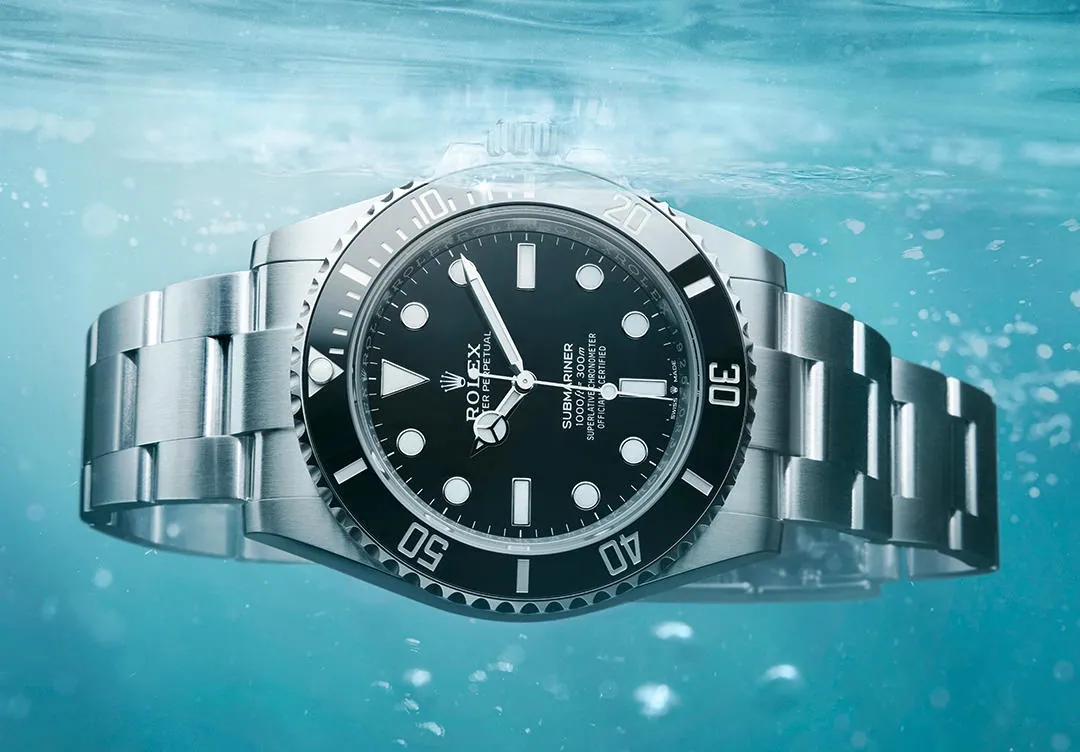
Seventy years of changing one thing at a time and never the shape. From the 6204 at a hundred metres to ceramic and forty-one millimetres — and why each small change moves the price of everything before it.
The Submariner was not the first dive watch. Blancpain's Fifty Fathoms reached the market in the same season and, depending on who is telling it, a few months earlier. What Rolex had was the Oyster case, patented in 1926 and refined for twenty-seven years, and a rotating bezel that let a diver read elapsed time against it. The combination is why the word Submariner now means the category rather than the model.
Reference 6204 came in 1953, rated to a hundred metres, with a pencil-thin handset and no crown guards. The 6538 that followed had an oversized winding crown — collectors call it the Big Crown — and is the one Sean Connery wore, on a strap too short for him, in 1962. It had already been in production for years by then. The film made it famous rather than the other way round.
Crown guards arrived with the 5512 in 1959, and with them the profile the watch has kept ever since. The dials of this period were gilt: gloss black lacquer with the printing in gold, produced by a process Rolex abandoned around 1967 in favour of matte white printing. That change of process, invisible to anyone not looking for it, is worth multiples on the open market today.
The date model came in 1966 as the 1680, and it split the audience permanently. A Submariner without a date has a symmetrical dial and no lens on the crystal; a Submariner with one is more useful every morning. Sixty years on the argument has not resolved, and both are made, and the no-date is the one collectors prefer while the date is the one that sells.
1979 brought the 16800: sapphire crystal, three hundred metres, and a unidirectional bezel that could only ever shorten your remaining air rather than lengthen it. That is the last change made for divers. Everything after it is metallurgy.
Ceramic came in 2008. Rolex calls it Cerachrom, and the point of it is that an aluminium bezel fades and scratches while a ceramic one does not. The market's response was contrary and entirely predictable: faded aluminium bezels, once a defect, became desirable overnight, and a ghosted bezel on a 16610 now adds to the price rather than subtracting from it.
In 2020 the case went to forty-one millimetres with the 3235 movement inside, and the lugs were slimmed so it wore smaller than the number suggests. It is the largest revision in forty years and it changed the shape of nothing.
Read as a whole, the Submariner is an argument for restraint. Seventy years, perhaps eight genuinely significant changes, and every one of them retroactively made the previous version collectible. A house that redesigned it every five years would have a more modern watch and no market at all in its old ones.
Questions about a specific reference? Ask us directly.